Gajar ka halwa: how it is made properly, and the mistakes to avoid
Gajar ka halwa is grated red carrots cooked down in milk, then roasted in ghee with sugar, khoya and nuts. Here is the traditional method, why the carrots matter, and the mistakes that make it watery or dull.
Gajar ka halwa is made by cooking grated red winter carrots slowly in milk until the milk has dried up, then roasting the mixture in desi ghee with sugar until it is glossy and rich, and finishing it with khoya, cardamom and nuts. The two things that matter most are the carrots, which should be the red winter kind, and patience.
It is the best-loved dessert of the Pakistani winter, served at weddings and dinner parties from December to February. It is also easy to get wrong: watery, dull in colour, too sweet or tasting of raw carrot. This guide explains the traditional method, the reason for each step, and how to avoid the common mistakes.
Gajar ka halwa in short
- Use deep red winter carrots, grated coarsely.
- Cook them in full-cream milk until the milk is gone.
- Add sugar only when the carrots are soft.
- Roast in desi ghee until glossy and the ghee shows at the edges.
- Finish with khoya, cardamom, almonds and pistachios.
Why this is a winter dish
Gajar ka halwa exists because of one vegetable. Every winter, markets across Punjab fill with long, slender carrots of a deep crimson colour, sometimes called desi or lal gajar. They are sweeter and juicier than the orange carrots sold through the rest of the year, with a softer core and a distinct flavour.
These carrots are in season for only a few months. That is why the halwa appears in December and disappears by March, and why it tastes like winter to anyone who grew up here. It belongs with the other cold-weather foods we have described in the winter foods of Punjab.
The ingredients
- Carrots. About 1 kg of red winter carrots.
- Milk. 1 litre of full-cream milk. Buffalo milk is ideal.
- Sugar. About ¾ to 1 cup, to taste. Red carrots are sweet, so start with less.
- Desi ghee. 4 to 6 tablespoons.
- Khoya. 150 to 200 g, optional but traditional.
- Green cardamom. Seeds of 6 to 8 pods, ground.
- Nuts. Almonds and pistachios, sliced; cashews and raisins if you like.
Quantities are a guide. Every family adjusts the sugar, ghee and khoya to its own taste.
The traditional method, step by step
1. Prepare the carrots
Wash and peel the carrots and trim the ends. If the core is pale and woody, as it sometimes is in very large carrots, cut it out. Grate the carrots on the coarse side of the grater. Fine grating turns to mush; coarse shreds keep a little texture.
Grating a kilo by hand takes time. A food processor with a grating disc is perfectly acceptable. Do not blend the carrots to a paste.
2. Cook the carrots in milk
Put the grated carrots and milk in a wide, heavy pan, a karahi or a large pot. Bring to the boil, then lower the heat to a steady simmer.
Cook, stirring every few minutes and scraping the bottom, until the milk has reduced and been absorbed and the mixture is thick and almost dry. This takes forty-five minutes to an hour or more, depending on the pan. As the milk reduces it forms small granules of milk solids that cling to the carrots. That is the richness of the dish being made.
3. Add the sugar
When the milk has gone and the carrots are soft, add the sugar. The mixture will turn loose and wet again as the sugar melts and draws out moisture. This is expected. Keep cooking and stirring until that liquid has evaporated too.
4. Roast in ghee (bhunai)
Add the desi ghee. Now stir more or less constantly over medium-low heat. The halwa will darken to a deep red-orange, turn glossy and begin to come away from the sides of the pan. You will see ghee glistening at the edges. This roasting stage, called bhunai, is what gives halwa its depth of flavour and its shine. It takes ten to fifteen minutes.
5. Finish
Crumble in most of the khoya and stir until it has melted into the halwa. Add the ground cardamom and most of the nuts. Cook for two or three minutes more. Turn into a serving dish and top with the remaining khoya and nuts.
Why each step matters
| Step | What it does | If you skip or rush it |
|---|---|---|
| Coarse grating | Keeps texture | Paste-like halwa |
| Cooking in milk | Softens carrots and builds milk solids | Thin flavour; carrots taste raw |
| Sugar after softening | Lets carrots cook through first | Tough, chewy shreds |
| Drying after sugar | Removes released water | Watery halwa that weeps |
| Bhunai in ghee | Develops colour, gloss and deep flavour | Dull, boiled taste |
| Khoya at the end | Adds richness without overcooking it | Khoya turns grainy and oily |
The quicker methods
Not everyone has two hours. There are honest shortcuts, each with a small cost in flavour.
- Carrots first, khoya for richness. Cook the grated carrots in a little ghee, covered, until soft and their water has evaporated. Add sugar, dry it out, then add a generous amount of khoya. No milk is reduced. This is how many halwais and busy homes do it.
- Condensed milk. Soften the carrots, then add a tin of sweetened condensed milk in place of milk, sugar and khoya. Quick and reliable, with a slightly different, more toffee-like taste.
- Milk powder. Stir dry milk powder into the cooked, sweetened carrots at the end to stand in for khoya.
- Pressure cooker. Cook carrots and milk under pressure for one or two whistles, then open the lid and reduce. It saves time on softening, not on drying.
The slow milk method gives the best result, because the milk solids form around each shred. But a carefully made shortcut halwa is far better than none.
Common mistakes
- Using orange carrots and expecting the same dish. It will be paler and less sweet. Adjust sugar and time, and do not add food colour to compensate.
- Grating too fine. The halwa loses all texture.
- Adding sugar too early. The carrots stay firm.
- Stopping when it still looks wet. Halwa that has not been dried and roasted properly leaks liquid on the plate and spoils faster.
- Too little ghee, or none. The bhunai stage needs fat. Without it the halwa tastes boiled.
- Burning the bottom. Milk catches easily. Use a heavy pan, keep the heat moderate and scrape the base as you stir.
- Too much sugar. Red carrots are sweet already. Taste before adding the full amount.
- Using banaspati in place of desi ghee. It leaves a waxy film and a flat taste. See what is desi ghee.
- Stale nuts. One rancid almond is enough to notice. Taste nuts before using them.
Variations
- With gur. Replace the sugar with grated gur or shakkar. Add it once the milk has fully dried, on low heat. The colour will be darker and the flavour deeper and more caramel.
- Without khoya. Use an extra half litre of milk and reduce it fully.
- With saffron. A few soaked threads at the end add fragrance. See how to identify real saffron.
- Less rich. Reduce the ghee and leave out the khoya for an everyday version.
- Gajrela. A different dish: carrots and a little rice simmered in plenty of milk into a pourable kheer. More in kheer, firni and sheer khurma.
How to serve it
Gajar ka halwa is best warm. Reheat it gently in a pan with a teaspoon of ghee or a splash of milk, stirring, until soft and glossy again.
- On its own, in small bowls, topped with nuts.
- With a spoon of cold malai, rabri or vanilla ice cream on top of the warm halwa.
- Alongside kheer or firni on a winter dessert table.
- With a cup of Kashmiri chai after dinner.
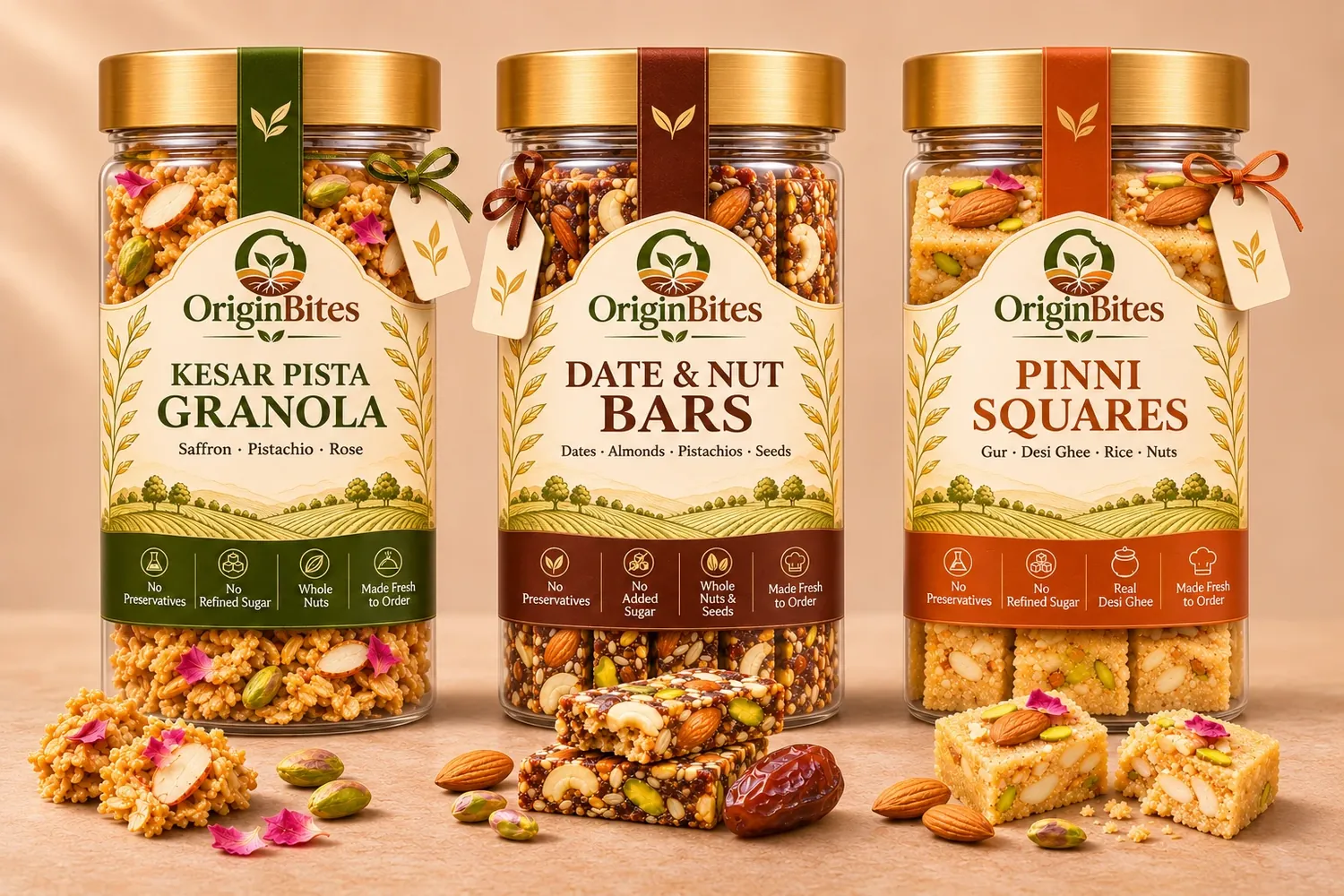
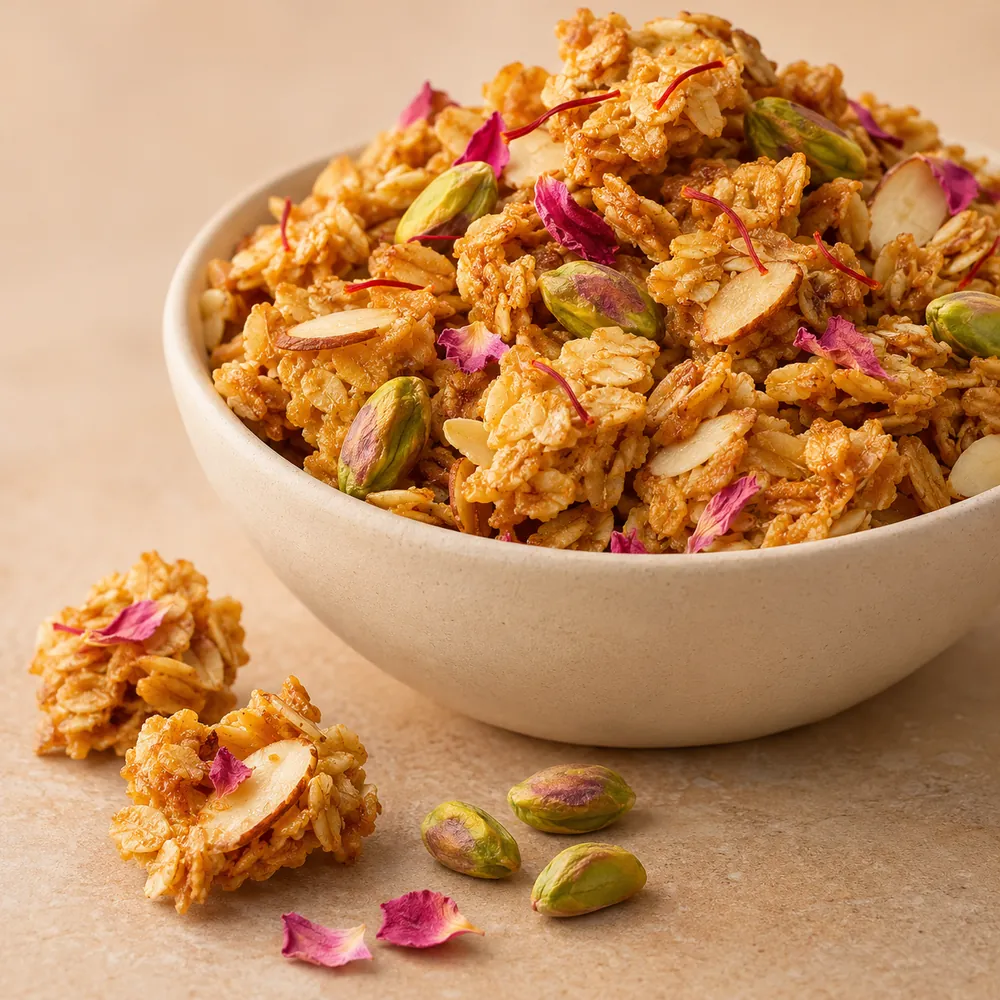
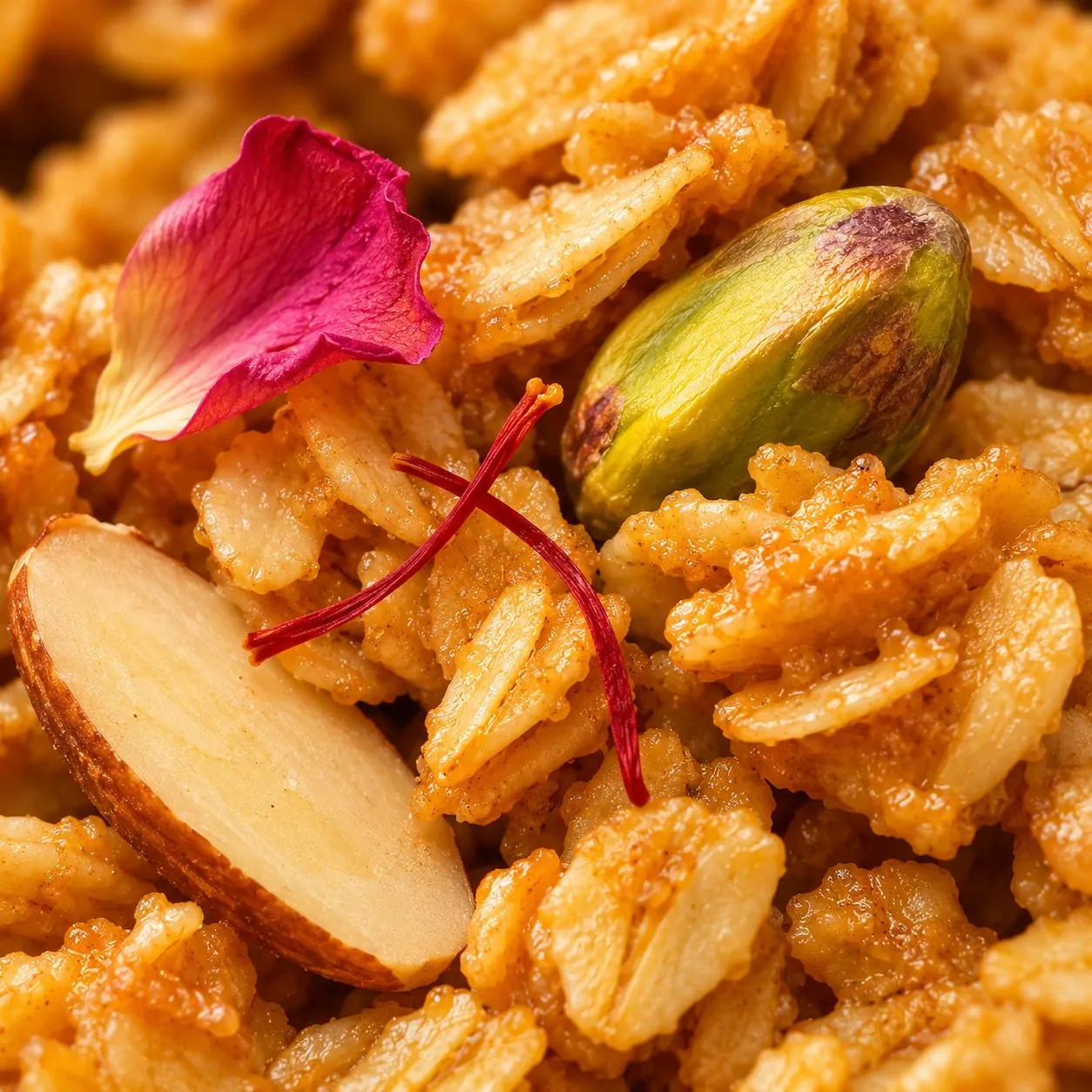
For a contrast of textures, a spoonful of crisp granola over warm halwa works very well. The saffron and pistachio in our Kesar Pista Granola suit it naturally.
Storing and freezing
- Cool the halwa completely before covering it.
- Store in an airtight container in the fridge.
- Use a clean, dry spoon each time.
- Eat within about a week. Halwa that was cooked until properly dry keeps better than a wet one.
- For longer keeping, freeze it in portions. Thaw in the fridge and reheat in a pan.
Because the season is short, many households make a large batch in January and freeze some for later. If it ever smells sour or shows mould, throw it away.
Buying it ready-made
Sweet shops sell gajar ka halwa by the kilo through the winter. Quality varies a great deal.
- Colour. A natural deep orange-red. A bright, uniform red or orange suggests added colour.
- Shine and smell. It should smell of ghee and milk. A waxy look and flat smell point to banaspati.
- Texture. Visible shreds of carrot and granules of khoya, not a smooth paste.
- Freshness. Ask when it was made. A tray that has sat in an open counter for days is not the same food.
A note on richness
Gajar ka halwa is carrots, but it is also milk, sugar, ghee and khoya. It is a festive dessert, meant for small bowls on cold evenings. We describe it as part of our food culture and make no health claims for it. If you have been advised to limit sugar or fat, enjoy it accordingly.
Planning a batch
Gajar ka halwa shrinks a great deal as it cooks. A kilo of carrots and a litre of milk give roughly 600 to 700 grams of finished halwa, enough for six to eight small servings. For a dinner party, allow about 150 grams of raw carrot per guest.
| Carrots | Milk | Sugar | Ghee | Khoya | Serves |
|---|---|---|---|---|---|
| ½ kg | ½ litre | ⅓ to ½ cup | 2 to 3 tbsp | 75 to 100 g | 3 to 4 |
| 1 kg | 1 litre | ¾ to 1 cup | 4 to 6 tbsp | 150 to 200 g | 6 to 8 |
| 2 kg | 2 litres | 1½ to 2 cups | 8 to 10 tbsp | 300 to 400 g | 12 to 16 |
Larger batches take proportionally longer to reduce, so use the widest pan you have. Two medium pans are quicker than one deep one.
If you are cooking for a crowd, start earlier than you think you need to. The reducing cannot be hurried by turning up the heat, because milk scorches. A calm two hours at a low flame gives a far better halwa than one rushed hour at a high one, and it reheats beautifully, so finishing early does no harm at all.
A sensible timetable
- The day before: wash, peel and grate the carrots. Keep them covered in the fridge.
- Morning: cook with milk while you do other things nearby, stirring every few minutes.
- Midday: sugar, then the ghee roasting, which needs your full attention for fifteen minutes.
- Before serving: reheat gently and add the khoya and nuts.
Worth the stirring
There is no trick to gajar ka halwa. It asks for the right carrots, good milk, real ghee and someone prepared to stand at the stove. The reward is a dish that cannot be made at any other time of year, and that tastes, more than almost anything else, like home in winter.
If you enjoy cooking the slow, traditional way, you may also like our guide to pinni, the winter sweet of Punjab.
Common questions
Which carrots are best for gajar ka halwa?
The long, deep red carrots that appear in Pakistani markets in winter. They are sweeter, juicier and softer than orange carrots and give the halwa its colour and flavour.
Can I make gajar ka halwa with orange carrots?
You can, but the result is paler, less sweet and a little more fibrous. You may need a bit more sugar and a longer cooking time.
When should sugar be added?
Only after the milk has dried up and the carrots are completely soft. Sugar added early draws out water and stops the carrots softening.
Is khoya necessary?
No. The traditional method reduces milk with the carrots, which gives the same richness. Khoya is a quicker way to add it, and many cooks use both.
Why is my halwa watery?
It was not cooked long enough after the sugar was added, or the carrots were not squeezed of excess water. Sugar releases liquid, which must be cooked off before the halwa is done.
How long does gajar ka halwa keep?
It is a milk-based dessert. Keep it covered in the fridge and eat it within about a week. It also freezes well. If it smells sour, discard it.
What is the difference between gajar ka halwa and gajrela?
Gajar ka halwa is cooked until dry and rich. Gajrela is a pourable carrot kheer made with carrots, rice and plenty of milk.
This article is general information about food. It is not medical advice.
Share
Send on WhatsAppKeep reading.

Pinni and panjiri: what is the difference?
Pinni and panjiri start the same way: flour roasted slowly in desi ghee with nuts. Then they part. One is bound and shaped, the other is left as a loose crumble. Here is the full comparison.
Read the article
Winter foods of Punjab: what our elders made, and why
From sarson ka saag at lunch to peanuts in the afternoon sun and pinni at night, Punjab eats differently in winter. Here is the traditional cold-weather table, and the practical reasons behind it.
Read the article
Kheer, firni and sheer khurma: what is the difference?
All three are milk cooked down with something to thicken it, sweetened and scented with cardamom. Kheer uses whole rice, firni ground rice, and sheer khurma vermicelli and dates. Here is the full comparison.
Read the articleFrom our kitchen.
Kesar Pista Granola
Big clusters, not loose oats. Whole pistachios and sliced almonds.


Pinni Squares
Roasted in real desi ghee. Gur, not white sugar.
Date & Nut Bars
Held together by dates alone. Whole nuts you can see.