Gur and white sugar: how they differ in making, taste and cooking
Gur and white sugar begin as the same cane juice and end as two very different foods. Here is an honest comparison of how each is made, how it tastes, how it cooks, and what the difference does and does not mean.
Gur and white sugar both begin as sugarcane juice. Gur is that juice boiled down and set solid, with everything left in. White sugar is what remains after a mill has separated the pure sugar crystals from the rest and washed them clean. So gur is brown, soft and tastes of caramel, while sugar is white, dry and tastes only sweet. Both are sugar.
That last sentence is the one most comparisons leave out. This article sets the two side by side honestly: how each is made, how they taste and cook, how they keep, what they cost, and what the difference between them does and does not mean.
Gur and sugar in short
- Same plant, same juice, different roads.
- Gur: boiled and set, nothing removed. Golden to brown, caramel taste.
- Sugar: crystals separated and refined. White, neutral, very consistent.
- Both are mostly sugar and should be eaten with the same sense.
- Choose gur for flavour and tradition, sugar for neutrality and precision.
One plant, two roads
Sugarcane grows across Punjab, Sindh and Khyber Pakhtunkhwa. When it is cut in late autumn, it can go one of two ways. A share is crushed on the farm or in the village and boiled into gur in open pans. The larger share is loaded onto trolleys and taken to a sugar mill.
The cane is identical. Everything that makes gur and sugar different happens after the juice leaves the crusher.
How gur is made
The juice is poured into a wide iron pan over a fire fed with dried cane stalks. As it heats, impurities rise as scum and are skimmed off by hand. The juice boils for two to three hours until it is thick and dark, then it is poured out, beaten with a paddle as it cools, and shaped into blocks or rubbed into powder as shakkar. The full process is described in what is gur?
The key point is that nothing is separated. The sugar, the molasses and the small amounts of everything else in the juice all end up in the block. It is a simple, small-scale process that a family can run with one pan.
How white sugar is made
A sugar mill does on an industrial scale what gur making does not attempt: it pulls the pure sucrose out of the juice.
- Crushing. Cane is shredded and pressed through heavy rollers to extract the juice.
- Clarifying. The juice is heated and treated, commonly with lime and often with sulphur dioxide, so that impurities clump and settle.
- Evaporating. The clear juice is boiled under vacuum into a thick syrup.
- Crystallising. The syrup is boiled further and seeded so that sugar crystals grow.
- Centrifuging. The mixture is spun at high speed. The crystals stay in the basket; the dark syrup, molasses, is thrown out through the mesh.
- Refining and drying. The crystals are washed, sometimes dissolved, filtered and crystallised again, then dried and sieved.
What comes out is almost pure sucrose. The molasses that was removed is sold on for animal feed, for making industrial alcohol and for other uses.
Side by side
| Gur | White sugar | |
|---|---|---|
| Made from | Whole sugarcane juice | Sucrose crystals separated from cane juice |
| Where it is made | Small open-pan units near the fields | Large mills |
| Molasses | Kept | Removed |
| Colour | Golden to dark brown | White |
| Texture | Soft, slightly moist block or powder | Dry, hard, free-flowing crystals |
| Taste | Caramel, cane, sometimes smoky | Clean and neutral |
| Consistency | Varies by maker, village and season | The same every time |
| Keeping | Draws moisture; needs an airtight jar | Keeps almost indefinitely if dry |
| Main risk for buyers | Poor skimming, bleaching, added matter | Very little; it is a standard product |
Taste
This is where gur wins without argument. White sugar is designed to taste of nothing but sweetness, which is exactly what you want in a cup of delicate tea or a sponge cake. Gur brings a whole flavour of its own: toffee, butterscotch, a little smoke, a faint mineral edge. In chai, in halwa, in a paratha with ghee, that flavour is the point.
It also varies. Peshawari gur does not taste like gur from south Punjab. New-season gur is brighter than a block that has sat through the summer. People who care about gur care about these differences the way others care about mangoes.
In the kitchen
The two behave differently when you cook with them, and knowing how saves a lot of failed sweets.
- Moisture. Gur holds a little water. Sweets made with it stay softer and chewier. Sugar gives crispness and a clean snap.
- Colour. Gur darkens everything. A kheer made with gur is the colour of milky tea, not white.
- Milk. Gur can split hot milk because it is slightly acidic and often carries traces from clarifying. Add it off the boil, at the end. Sugar never does this.
- Burning. Gur browns and burns faster than white sugar. Keep the heat lower in baking and when making syrups.
- Dissolving. Sugar dissolves quickly and clear. Gur needs to be grated or melted with a little water, and it is wise to strain the syrup.
- Measuring. Sugar is exact. Gur varies in sweetness and moisture from block to block, so taste and adjust.
When to use which
Reach for gur in winter sweets such as pinni, panjiri, gajak and til ke laddu; in gur walay chawal; in imli chutney and achar; in doodh patti on a cold night; and in baking that welcomes caramel, such as oat biscuits and granola.
Reach for sugar where you need neutrality, whiteness or precision: sponge cakes, meringue, rasgulla syrup, sherbets, jams where the fruit should lead, and everyday tea if you prefer it plain.
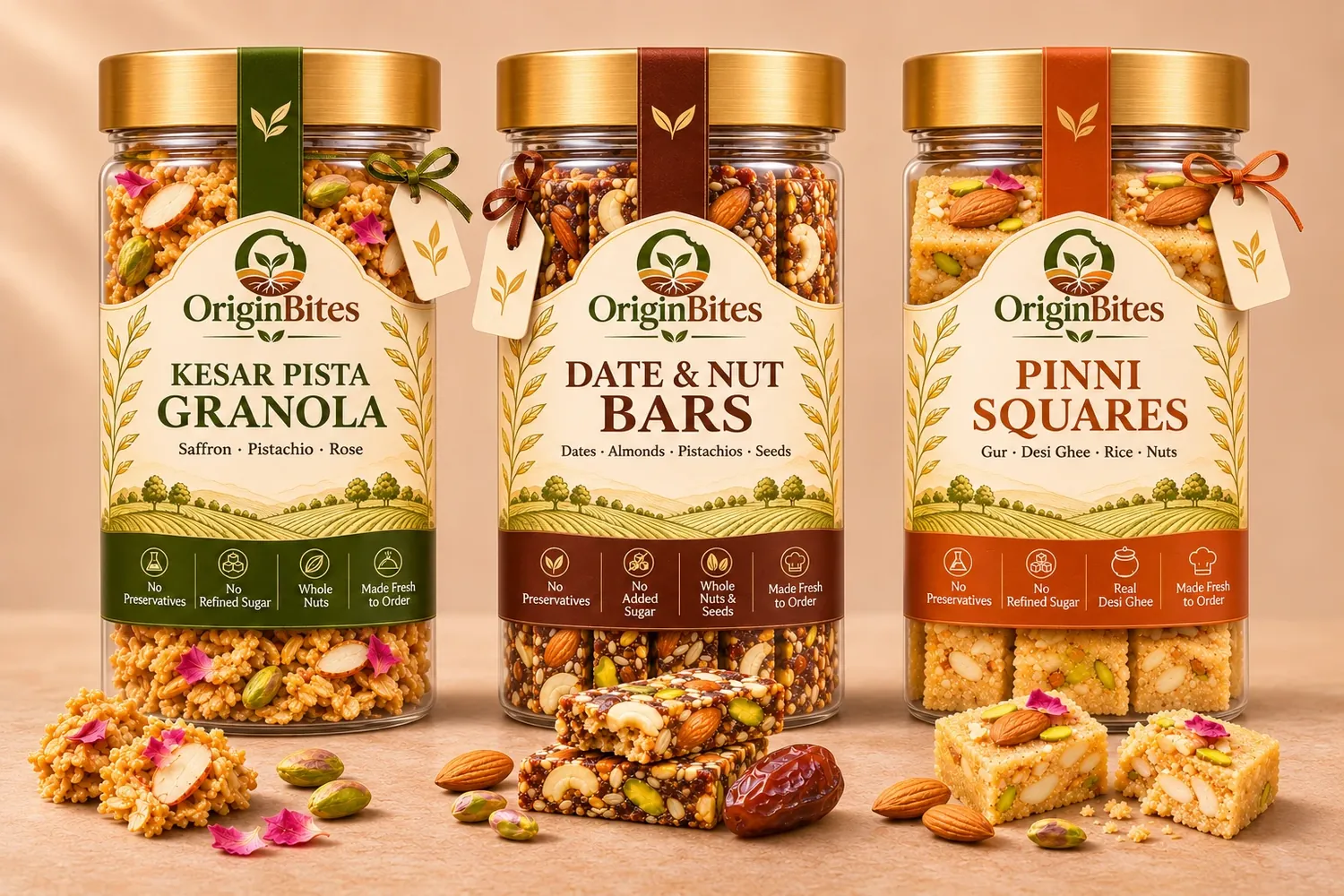
In our own kitchen we use light gur. It melts into roasted rice flour in our Pinni Squares, and together with honey it binds the oat clusters in our Kesar Pista Granola. We use no refined white sugar, and we chose that for flavour and for the kind of food we want to make, not because we think gur is a medicine.
The relatives: shakkar, desi khand, brown sugar
- Shakkar is gur in powder form, made by stirring and rubbing the thick syrup as it cools. Same food, different shape.
- Desi khand is a traditional, partly drained raw sugar: pale brown crystals with some molasses left on. It sits between gur and white sugar.
- Brown sugar in supermarkets is usually white sugar with molasses sprayed back on. It is closer to white sugar than to gur.
- Bura is powdered sugar made by boiling and beating sugar syrup. It is used in laddus and panjiri for its fine, melting texture.
- Misri is rock sugar: large, clear crystals of white sugar.
What the difference does not mean
You will often read that gur is “healthy” and white sugar is “poison”. Neither statement is fair, and we do not want to add to the confusion.
It is true that gur is less processed and that the molasses it keeps contains small amounts of minerals. It is also true that the amounts are small compared with what you get from ordinary foods such as dal, vegetables and meat, and that gur is, by weight, mostly sugar. Your body handles the sugar in gur much as it handles the sugar in a spoonful from the bowl.
So gur is not a way to eat sweet things without consequence. If a doctor has told you to limit sugar, that advice covers gur, shakkar, honey and dates as well. The honest reasons to choose gur are its taste, its place in our cooking, and the fact that it is a simple food made in a simple way.
Buying and keeping
Sugar is easy: any clean, dry, free-flowing white sugar from a sealed bag does the job. Keep it in a closed container so it does not take on damp or smells.
Gur takes more care. Choose a natural golden to brown colour, a firm block and a warm caramel smell, and be suspicious of gur that is very pale and bright. Store it airtight, cool and dry. Our full guide to choosing and keeping it is in what is gur?
Price
White sugar is usually the cheaper of the two per kilo in Pakistan. It is made by the million tonnes in mills that run day and night. Good gur is made in small batches by hand and costs more to produce, and the best lots are bought up quickly. Prices of both swing with the cane crop and the season, so we will not quote figures that will be out of date by the time you read this.
A simple taste test at home
The quickest way to understand the difference is to taste it. Make two small cups of plain black tea. Sweeten one with a teaspoon of white sugar and the other with the same weight of grated gur. Sip them side by side.
The sugar cup tastes of tea, made sweet. The gur cup tastes rounder and darker, with a caramel note that changes the tea itself. Neither is wrong. They are simply different drinks. Try the same with a spoon of each stirred into plain dahi, and with a little melted over a hot paratha.
Things people often get wrong
- “Gur has no sugar in it.” Gur is mostly sugar.
- “Lighter gur is purer.” Often the opposite. Very pale, bright gur has frequently been treated to look that way.
- “Brown sugar is the same as gur.” Shop brown sugar is usually white sugar with molasses added back.
- “Jaggery powder is something different.” It is shakkar: gur in powder form.
- “White sugar is full of chemicals.” Refined sugar is almost pure sucrose. Processing aids are used in making it, but the finished crystal is a very simple substance.
- “You can swap them freely in any recipe.” In most desi cooking, yes. In delicate baking, the extra moisture and colour of gur change the result.
- “Honey and dates do not count.” They are sugars too, and belong in the same sensible limit.
Why we still choose gur
Sugar is a triumph of engineering. It is cheap, clean, consistent and useful. But it has no memory of the plant it came from. Gur does. You can taste the field and the fire in it.
For most of our history, the people of this region sweetened their food with gur made within walking distance of their homes. Choosing it today keeps a craft alive and gives your cooking a flavour that white sugar cannot. That is reason enough. It does not need to be a health claim as well.
If you would like to read labels with a sharper eye for all the names sugar goes by, see how to read a food label in Pakistan.
Common questions
Is gur healthier than sugar?
We do not make that claim. Gur is less processed and keeps small amounts of the minerals and other compounds in cane juice, but it is still mostly sugar and should be eaten in the same sensible amounts as any sweetener.
Can people with diabetes eat gur?
Gur raises blood sugar, as white sugar does. Anyone with diabetes should follow their own doctor's advice and not treat gur as a free food.
Does gur have fewer calories than sugar?
Not in any way that matters. Weight for weight they are close. Gur contains a little more water, so it is very slightly lower, but the difference is small.
Why is gur brown and sugar white?
Gur keeps the molasses, the dark syrup naturally present in cane juice. In sugar refining the molasses is spun away and the crystals are washed and filtered until they are white.
Is brown sugar the same as gur?
No. Most brown sugar sold in shops is refined white sugar with some molasses added back. Gur was never refined in the first place.
Can I replace sugar with gur one for one?
By weight, roughly yes, in most desi sweets, sauces and chai. Expect a darker colour, a caramel taste and a slightly softer, moister result. Delicate cakes and meringues behave differently.
Which is cheaper in Pakistan?
White sugar is usually cheaper per kilo than good gur, because it is produced on an industrial scale. Prices of both move a great deal from season to season.
This article is general information about food. It is not medical advice.
Share
Send on WhatsAppKeep reading.

Saffron (kesar): how it is grown, why it costs so much, and how to identify real saffron
Saffron is the dried threads of a small purple flower, picked by hand. Here is why it is the most expensive spice, how fakes are made, what real kesar looks and smells like, and how to use it well.
Read the article
Almonds, pistachios, cashews and walnuts: a dry fruit buying guide for Pakistan
Dry fruit is expensive and quality varies widely. Here is how to judge almonds, pistachios, cashews, walnuts and chilgoza in a Pakistani bazaar: the kinds, the grades, the tricks, and five checks that work on all of them.
Read the article
How to identify pure honey in Pakistan: kinds, labels and what home tests can and cannot tell you
Honey is one of the most commonly adulterated foods, and most home tests for it do not work. Here is what honey is, the kinds made in Pakistan, why it crystallises, and how to buy it with more confidence.
Read the articleFrom our kitchen.
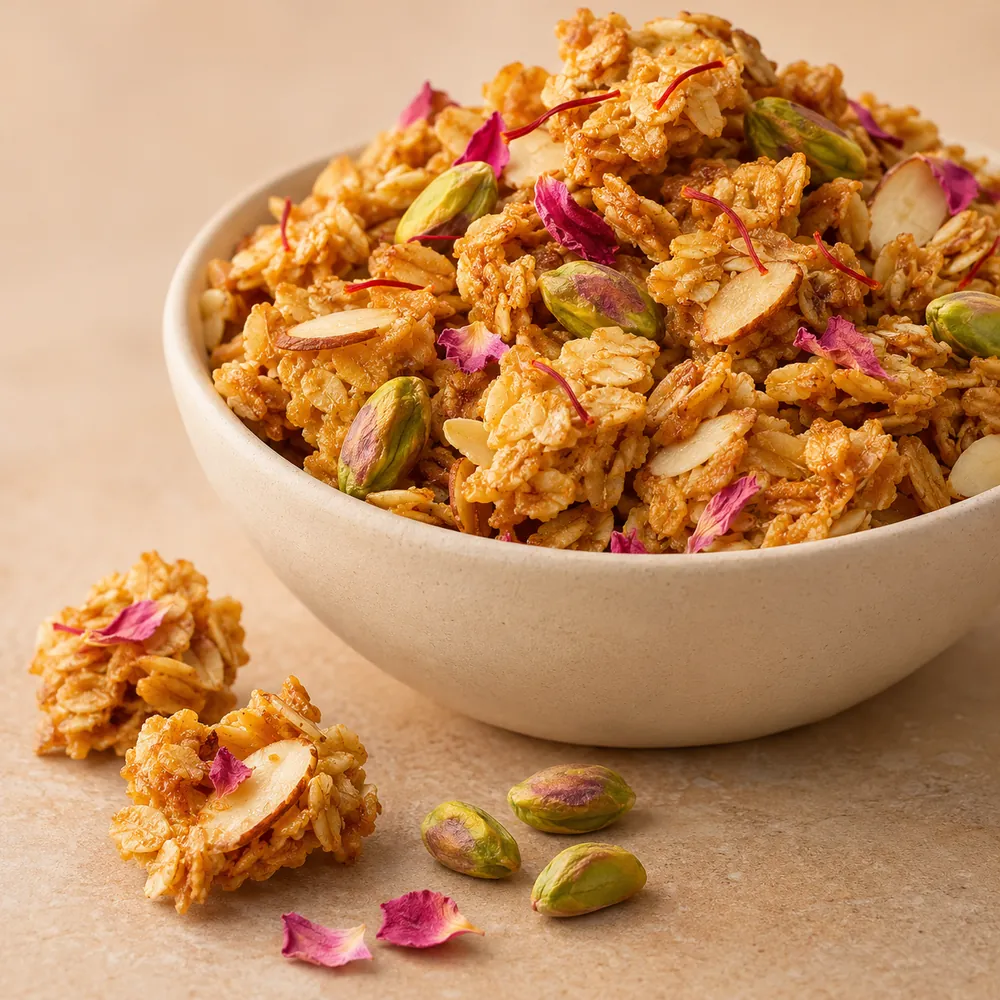
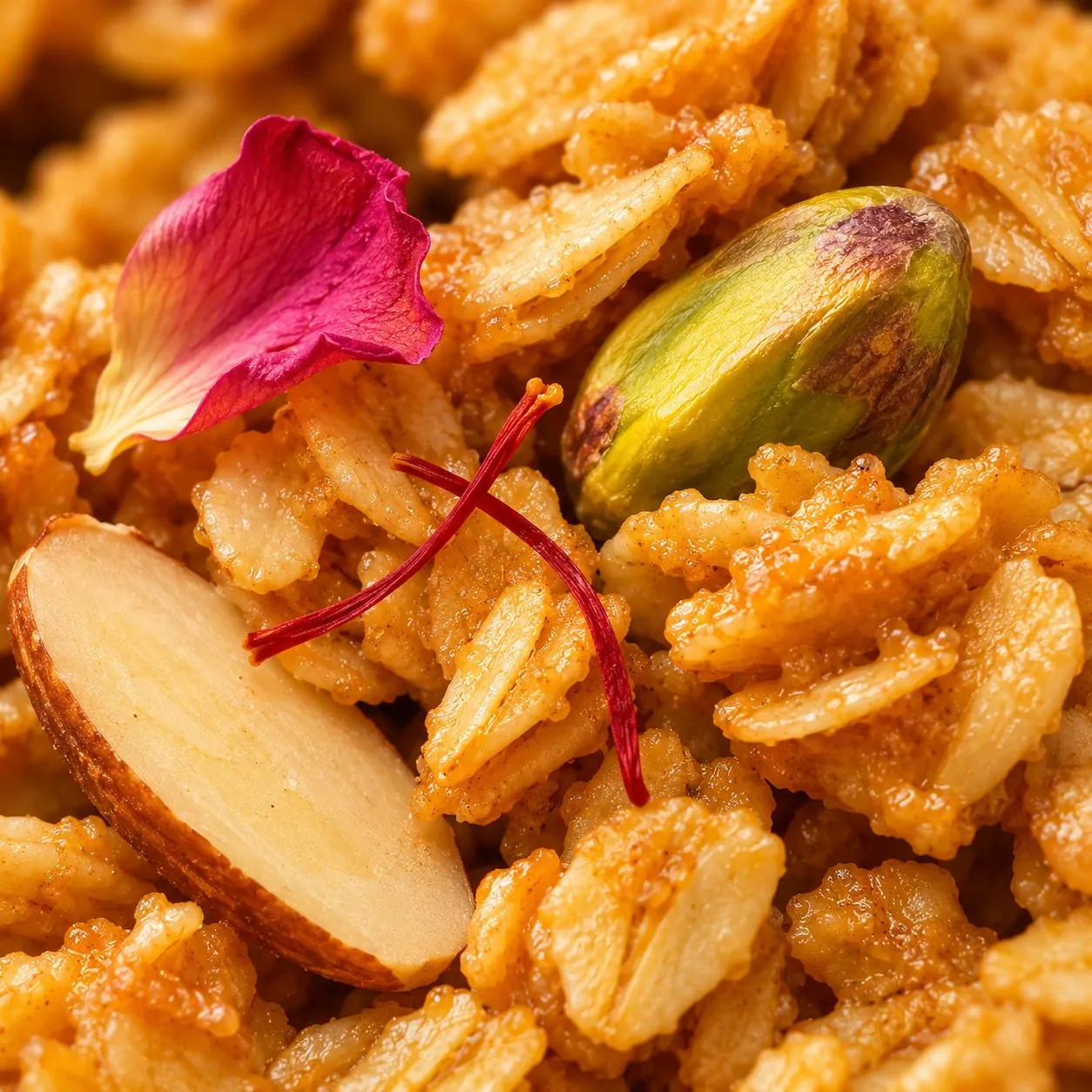
Kesar Pista Granola
Big clusters, not loose oats. Whole pistachios and sliced almonds.


Pinni Squares
Roasted in real desi ghee. Gur, not white sugar.
Date & Nut Bars
Held together by dates alone. Whole nuts you can see.